UNA MEMORIA DEL MARE (Traduzione di Emilio Capaccio)
O cielo e mare, e verso di chiurlo, Il sonoro scampanio dell’onda sull’onda, Perle di sogno che il più fondo oceano pavimenta, La potente meraviglia su tutto!
Il vasto, vasto mare dove cavalcano grandi navi, La brezza aperta con pieno respiro, La pallida schiuma atterrita dalla tempesta, I tristi cancelli del cielo spalancati!
*
A SEA-MEMORY
O sky and sea, and curlew call, The tinkling chime of wave on wave, Dream-pearls that deepest ocean pave, The mighty wonder over all!
The wide, wide sea, where great ships ride, The open breeze with breath full drawn, Pale foam by tempest frightened on, Grim flood-gates of the sky flung wide!
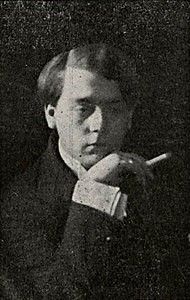
Arthur Williams Symons (1865-1945), gallese (foto web)
PRIMA DELLA TEMPESTA (Traduzione di Emilio Capaccio)
Il vento s’alza sul mare, saltano le bianche e battute schiume ballerine; e il mare geme con malessere, e torna a dormire, e non può dormire.
La cresta dietro il dorsale roccioso si solleva, mani selvagge, e martelli sulla terra, si disperde in polvere liquida alla deriva verso la morte tra la sabbia polverosa.
Sulla linea dell’orizzonte che s’avvicina, dove il cielo poggia un muro visibile, bigio alla vista, io divinizzo, le vele che volano prima della tempesta.
*
BEFORE THE SQUALL
The wind is rising on the sea, the windy white foam-dancers leap; and the sea moans uneasily, and turns to sleep, and cannot sleep.
Ridge after rocky ridge uplifts, wild hands, and hammers at the land, scatters in liquid dust, and drifts to death among the dusty sand.
On the horizon’s nearing line, where the sky rests a visible wall, grey in the offing, I divine, the sails that fly before the squall.
Christina Georgina Rossetti (1830-1894), inglese (foto web)
DAL MARE (Traduzione di Emilio Capaccio)
Perché il mare geme sempre? Escluso dal cielo, emette il suo lamento. S’agita contro il bordo della riva; Tutti i fiumi in piena della terra non possono riempire Il mare, che beve e ha ancora sete.
Puri miracoli di bellezza giacciono nascosti nel suo letto non visti: Anemoni, salsi, senza passione, Come fiori respirano; sono vivi quanto basta per respirare, moltiplicarsi e prosperare.
Gusci pittoreschi, curvi, a chiazze, a punte, cose vive incrostate con occhi da argo, tutti belli e uguali, ma tutti diversi, nascono senza dolore e muoiono senza dolore, —e così passano.
*
BY THE SEA
Why does the sea moan evermore? Shut out from heaven it makes its moan. It frets against the boundary shore; All earth’s full rivers cannot fill The sea, that drinking thirsteth still.
Sheer miracles of loveliness Lie hid in its unlooked-on bed: Anemones, salt, passionless, Blow flower-like; just enough alive To blow and multiply and thrive.
Shells quaint with curve, or spot, or spike, Encrusted live things argus-eyed, All fair alike, yet all unlike, Are born without a pang, and die Without a pang,—and so pass by.
William Stanley Braithwaite (1878-1962), americano (foto web)
VOCE DEL MARE (Traduzione di Emilio Capaccio)
Voce del mare che mi chiami, Cuore dei boschi che il mio cuore ama, Sono parte del vostro mistero. Mosso dall’anima che la vostr’anima muove.
Sogno di stelle nella cupola del mare notturno, Da qualche parte nel vostro spazio infinito Dopo gli anni tornerò alla dimora, Alle vostre sale per reclamare il mio posto.
*
VOICE OF THE SEA
Voice of the sea that calls to me, Heart of the woods my own heart loves, I am part of your mystery— Moved by the soul your own soul moves.
Dream of the stars in the night-sea’s dome, Somewhere in your infinite space After the years I will come home, Back to your halls to claim my place.
Thomas Bailey Aldrich (1836-1907), americano (foto web)
LA VOCE DEL MARE (Traduzione di Emilio Capaccio)
Nel silenzio della notte autunnale Sento la voce del mare, Nel silenzio della notte autunnale Sembra che dica— Miei son i venti in alto, Mie le spelonche di sotto, Miei i morti di ieri E i morti di tanto tempo fa!
E penso alla flotta che salpò Dalla bella riva di Gloucester, Penso alla flotta che salpò E non tornò mai più! I miei occhi son pieni di lacrime, E il mio cuore intorpidito di dolore— Sembra come fosse ieri, E tutto è successo tanto tempo fa!
*
THE VOICE OF THE SEA
In the hush of the autumn night I hear the voice of the sea, In the hush of the autumn night It seems to say to me— Mine are the winds above, Mine are the caves below, Mine are the dead of yesterday And the dead of long ago!
And I think of the fleet that sailed From the lovely Gloucester shore, I think of the fleet that sailed And came back nevermore! My eyes are filled with tears, And my heart is numb with woe— It seems as if ‘t were yesterday, And it all was long ago!
Illustro l’argenteo passaggio d’una nave di notte, Il colpo d’ogni triste onda perduta, Il rombo calante dell’acciaio che si sforza, Il piccolo grido d’un uomo a un uomo, Un’ombra che cade nella notte più grigia, E il tramonto della piccola stella; Poi la distesa, la lontana distesa d’acque, E la soffice sferzata d’onde nere Per lungo tempo, in solitudine.
*
BLACK WAVES
I explain the silvered passing of a ship at night, The sweep of each sad lost wave, The dwindling boom of the steel thing’s striving, The little cry of a man to a man, A shadow falling across the greyer night, And the sinking of the small star; Then the waste, the far waste of waters, And the soft lashing of the black waves For long and in loneliness.
Nathaniel Hawthorne (1804-1864), americano (foto web)
L’OCEANO (Traduzione di Emilio Capaccio)
L’oceano ha le sue grotte silenziose, Profonde, quiete e solitarie; Anche se c’è furia sulle onde, Sotto di loro non c’è nessuno. I terribili spiriti degli abissi Hanno lì la loro comunione; E ci sono quelli per cui piangiamo, I giovani, i brillanti, i giusti. I marinai stanchi riposano tranquilli Sotto il loro mare blu. Le oceaniche solitudini sono benedette, Perché laggiù c’è purezza. La terra ha colpa, la terra ha affanno, Le sue tombe sono inquiete; Ma il placido sonno è sempre lì, Sotto le onde blu scuro.
*
THE OCEAN
The Ocean has its silent caves, Deep, quiet, and alone; Though there be fury on the waves, Beneath them there is none. The awful spirits of the deep Hold their communion there; And there are those for whom we weep, The young, the bright, the fair. Calmly the wearied seamen rest Beneath their own blue sea. The ocean solitudes are blest, For there is purity. The earth has guilt, the earth has care, Unquiet are its graves; But peaceful sleep is ever there, Beneath the dark blue waves.
Calarmi ancora nei mari, nel solitario mare e nel cielo, E tutto ciò che chiedo è un’alta nave e una stella per condurla, La gioia del timone, la canzone del vento, il tremolio della vela, Una nebbia grigia sul volto marino e una grigia alba nascente.
Calarmi ancora nei mari, perché il richiamo della corrente È un chiaro e selvaggio richiamo che non può essere negato; E tutto ciò che chiedo è un giorno di vento con bianche nubi volanti, Con spruzzi e spume sollevate e gabbiani che gridano.
Calarmi ancora nei mari, alla vita zingara e vagabonda, Sulla via di gabbiani e balene, dove il vento è un coltello affilato; E tutto ciò che chiedo è un’allegra storia da un ridente compagno, E un sonno tranquillo e un dolce sogno per quando il gioco è finito.
*
SEA FEVER
I must go down to the seas again, to the lonely sea and the sky, And all I ask is a tall ship and a star to steer her by, And the wheel’s kick and the wind’s song and the white sail’s shaking, And a grey mist on the sea’s face, and a grey dawn breaking.
I must go down to the seas again, for the call of the running tide Is a wild call and a clear call that may not be denied; And all I ask is a windy day with the white clouds flying, And the flung spray and the blown spume, and the sea-gulls crying.
I must go down to the seas again, to the vagrant gypsy life, To the gull’s way and the whale’s way, where the wind’s like a whetted knife; And all I ask is a merry yarn from a laughing fellow-rover, And quiet sleep and a sweet dream when the long trick’s over.
Ronald de Carvalho (1893-1935), brasiliano (foto web)
IL MERCANTE D’ARGENTO, ORO E SMERALDO (Traduzione di Emilio Capaccio)
Odora il mare! Odora il mare! Le reti pesanti battono come ali, le reti umide palpitano nel crepuscolo. La spiaggia liscia è una scintillazione di scaglie.
Saltellano nere razze nell’oro della sabbia bagnata, l’acciaio delle muggini luccica in mani d’ebano e di bronzo.
Muscoli, pinne, voci e fragori, tutto si mischia, tutto si mischia nel crearsi della schiuma che ferve tra gli scogli.
Odora il mare!
Il corno della luna nuova gioca sulla cresta dell’onda. E tra le alghe molli e i villosi molluschi, dove si trascinano granchi dalle zampe denticolate e dove bolle l’olio gelatinoso dei flessili calamari, nella rete immensa della notte carica di stelle, nella melodia libera delle acque e dello spazio, invasa d’aria, profetica, timpanica, scoppia orgogliosamente la chiacchera d’un piovanello…
*
O MERCADOR DE PRATA, DE OURO E ESMERALDA
Cheira a mar! cheira a mar! As redes pesadas batem como asas, as redes úmidas palpitam no crepúsculo. A praia lisa é uma cintilação de escamas.
Pulam raias negras no ouro da areia molhada, o aço das tainhas faísca em mãos de ébano e bronze. Músculos, barbatanas, vozes e estrondos, tudo se mistura, tudo se mistura no criar da espuma que ferve nas pedras.
Cheira a mar!
O corno da lua nova brinca na crista da onda. E entre as algas moles e os peludos mariscos, onde se arrastam caranguejos de patas denticuladas e onde bole o óleo gelatinoso das lulas flexíveis, diante de rede imensa na noite carregada de estrelas, na livre melodia das águas e do espaço, entupido de ar, profético, timpânico, estoura orgulhosamente o papo dum baiacu…
IN MEZZO ALL’OCEANO IN TEMPO DI GUERRA (Traduzione di Emilio Capaccio)
Il fragile splendore del mare piatto, Il volto sereno e d’argento velato della luna, Fanno di questa nave un luogo incantato Piena di chiara allegria e dorata magia. Ora, per un po’, la risata spensierata sarà Mescolata al canto, per dargli più dolce grazia, E le vecchie stelle, nella loro corsa infinita, Daranno ascolto e invidieranno la giovane umanità.
Eppure questa sera, a cento leghe di distanza, Queste acque arrossano d’uno strano e terribile rosso. Prima della luna, una nube oscenamente grigia Sorge da ponti schiantati nel piombo aereo. E queste stelle sorridono col loro modo immemorabile Sulle onde che ricadono su mille nuovi morti!
*
MID-OCEAN IN WAR TIME
The fragile splendour of the level sea, The moon’s serene and silver-veiled face, Make of this vessel an enchanted place Full of white mirth and golden sorcery. Now, for a time, shall careless laughter be Blended with song, to lend song sweeter grace, And the old stars, in their unending race, Shall heed and envy young humanity.
And yet to-night, a hundred leagues away, These waters blush a strange and awful red. Before the moon, a cloud obscenely grey Rises from decks that crash with flying lead. And these stars smile their immemorial way On waves that shroud a thousand newly dead!
Il testo inedito è tratto da “Canto di misconosciuta gloria“, in preparazione dalle Edizioni Multimedia di Salerno, nella traduzione dal greco di Maria Allo.
William Ernest Henley (1849-1903), inglese (foto web)
UN AMORE DAL MARE (Traduzione di Emilio Capaccio)
Sotto la notte che mi copre scevra di stelle, (O tribolazione del vento che rotola!) Nera come la nube di qualche tremendo incantesimo, Il sussurro del sospirante mare Pare il bisbiglio singhiozzante di due anime Che tremano in una passione d’addio.
Ai desideri che triplicarono in me la vita, (O malinconia del vento che rotola!) Ai sogni che sembrarono predire il futuro, Alle speranze che montarono in me come il mare, A tutte le dolci cose inviate sulle anime felici, Non posso che sciogliere un silente addio.
E alla fanciulla che fu sì tanto per me (O lamento di questo vento che rotola!) Poiché non posso costringela a vivere, Sotto la notte, accanto al mar che risuona, colmo dell’amor che avrebbe potuto unirci le anime, Un triste, ultimo, lungo, supremo addio.
*
A LOVE BY THE SEA
Out of the starless night that covers me, (O tribulation of the wind that rolls!) Black as the cloud of some tremendous spell, The susurration of the sighing sea Sounds like the sobbing whisper of two souls That tremble in a passion of farewell.
To the desires that trebled life in me, (O melancholy of the wind that rolls!) The dreams that seemed the future to foretell, The hopes that mounted herward like the sea, To all the sweet things sent on happy souls, I cannot choose but bid a mute farewell.
And to the girl who was so much to me (O lamentation of this wind that rolls!) Since I may not the life of her compel, Out of the night, beside the sounding sea, Full of the love that might have blent our souls, A sad, a last, a long, supreme farewell.
William Ellery Channing (1818–1901), americano (foto web)
CANZONE DEL MARE (Traduzione di Emilio Capaccio)
Va la nostra barca libera alle onde, sulla curva della marea, ove si frange il flutto ricciuto, come traccia di vento su bianchi fiocchi di neve: via, via! È un sentiero sul mare.
Possono infuriare le raffiche — far tendere la vela, perché i nostri spiriti sanno strappare al vento la forza, e le nubi plumbee cedono alla mente solare, non temiamo il turbine della burrasca.
Onde sulla spiaggia e schiuma marina selvaggia, con un balzo, uno scatto e un urrà improvviso, dove l’alga si lega alla sua dimora, e gli uccelli marini si bagnano sulle creste spumose, onda dopo onda, s’arricciano, mentre bianca la sabbia dalla riva acceca.
*
SEA SONG
Our boat to the waves go free, By the bending tide, where the curled wave breaks, Like the track of the wind on the white snowflakes: Away, away! ’Tis a path o’er the sea.
Blasts may rave,— spread the sail, For our spirits can wrest the power from the wind, And the gray clouds yield to the sunny mind, Fear not we the whirl of the gale.
Waves on the beach, and the wild sea-foam, With a leap, and a dash, and a sudden cheer, Where the seaweed makes its bending home, And the sea-birds swim on the crests so clear, Wave after wave, they are curling o’er, While the white sand dazzles along the shore.
NOSTALGIA DEL MARE (Traduzione di Emilio Capaccio)
A mille miglia oltre questo muro inondato di sole Da qualche parte le onde strisciano fresche lungo la sabbia, La bassa marea abbandona la terra indolente Con l’antico mormorio, lungo e musicale; Grevi di vento s’ergono le onde, si curvano, ricadono, E attorno agli scogli la schiuma esplode come neve — Ma benché lontana nell’entroterra, sento e riconosco, Perché sono nata eterna schiava del mare. Lì vorrei essere e rotolarmi addosso La fredda insistenza della marea, A spegnere questa cosa ardente che chiamano anima — Dopo con la risacca trascinarmi alla deriva Essere meno del più piccolo guscio lungo la secca, Meno dei gabbiani che strillano al mare.
*
SEA LONGING
A thousand miles beyond this sun-steeped wall Somewhere the waves creep cool along the sand, The ebbing tide forsakes the listless land With the old murmur, long and musical; The windy waves mount up and curve and fall, And round the rocks the foam blows up like snow, — Tho’ I am inland far, I hear and know, For I was born the sea’s eternal thrall. I would that I were there and over me The cold insistence of the tide would roll, Quenching this burning thing men call the soul, — Then with the ebbing I should drift and be Less than the smallest shell along the shoal, Less than the sea-gulls calling to the sea.
Sopra di me è la notte, E sopra la notte, la notte. Il mare accanto a me geme, o è quieto. La terra come una sonnambula si trascina Per uno strano sonno… Stride un uccello marino. E il garrulo risveglia in me fiocamente, Il popolo morto del mare, i miei antenati — Coloro che più di me sono in me, Coloro che si sedettero lunghe notti fa da sponde bagnate E videro il mare nei suoi silenzi; E lo dannarono o lo implorarono; O lo sfidarono con un crocifisso; E poi calarono giù con le loro barche.
Sopra di me è la notte… E sopra la notte, la notte. Le rocce mi circondano e più in là, la sabbia … E la riluttante bassa marea Che si getta all’indietro per dare l’ultimo saluto Ai relitti portati da così tempo nel suo seno. Rocce… Ma la marea arretra E il limo è nudo, come una cosa vergognosa Che non ha nascondiglio. E l’uccello marino tace — L’uccello e ogni altro grido lontano nel mio sangue — E la terra come una sonnambula si trascina.
*
SOMNAMBULISM
Night is above me, And Night is above the night. The sea is beside me soughing, or is still. The earth as a somnambulist moves on In a strange sleep… A sea-bird cries. And the cry wakes in me Dim, dead sea-folk, my sires — Who more than myself are me. Who sat on their beach long nights ago and saw The sea in its silence; And cursed it or implored; Or with the Cross defied; Then on the morrow in their boats went down.
Night is above me… And Night is above the night. Rocks are about me, and, beyond, the sand … And the low reluctant tide, That rushes back to ebb a last farewell To the flotsam borne so long upon its breast. Rocks… But the tide is out, And the slime lies naked, like a thing ashamed That has no hiding-place. And the sea-bird hushes — The bird and all far cries within my blood — And earth as a somnambulist moves on.
Stasera il cielo cupo e il mare si confondono; per tutto il giorno ha fatto molto caldo; le onde urtandosi nell’ombra si danno voci, prigioniere d’una stessa cella.
Il cielo è largo e nero come un panno funebre, e gli orizzonti incerti formano come un immenso e oscuro santuario dove tutti i ceri sono spenti.
Ma ecco che il mare diventa fosforescente e lungo la sabbia cangiante nella distanza s’apre superbo e abbagliante, con i suoi lustrini d’argento.
Non astri nel cielo, non vele nel vento, si direbbe che l’onda amara così rivolti impietosa cadaveri di stelle che sarebbero cadute nel mare.
*
PHOSPORESCENCE
Ce soir le ciel obscur et la mer se confondent; tout le jour il a fait très chaud; les flots entrechoqués dans l’ombre se répondent, captifs dans un même cachot.
Le ciel est large et noir comme un drap mortuaire, et les horizons incertains forment comme un immense et sombre sanctuaire où tous les cierges sont éteints.
Mais voici que la mer devient phosphorescente, et le long du sable changeant elle s’étale au loin superbe, éblouissante avec ses paillettes d’argent.
Pas d’astres dans le ciel; dans le vent pas de voiles; on dirait que le flot amer roule ainsi sans pitié des cadavres d’étoiles qui seraient tombés dans la mer!
William Vaughn Moody (1869-1910), americano (foto web)
UN GIORNO GRIGIO (Traduzione di Emilio Capaccio)
Nebbie grigie e piovigginose drappeggiano le brughiere, la pioggia sbianca il mare morto, dal tetro promontorio all’accigliato capo vele plumbee vanno stancamente. Non so come quel mercantile abbia trovato coraggio; ma è il suo piano verso il mare il suo corso sconfinato da solcare.
Irreali come insetti che atterriscono il cervello irritabile d’un ubriacone, sul grigio abisso strisciano le imbarcazioni a quattro zampe, con due rematori: minimi, i più piccoli della terra, attraverso la vasta circonferenza del vecchio oceano nello sforzo eroico, ridicolo.
Mi chiedo come l’equipaggio di quel mercantile abbia trovato la volontà. Mi chiedo come i pescatori facciano per continuare ancora a sfiancarli. Mi chiedo come il cuore dell’uomo abbia pazienza di vivere oltre la sua spanna o d’attendere che i suoi sogni s’avverino.
*
A GREY DAY
Grey drizzling mists the moorlands drape, rain whitens the dead sea, from headland dim to sullen cape grey sails creep wearily. I know not how that merchantman has found the heart; but ‘tis her plan seaward her endless course to shape.
Unreal as insects that appall a drunkard’s peevish brain, o’er the grey deep the dories crawl, four-legged, with rowers twain: midgets and minims of the earth, across old ocean’s vasty girth toiling-heroic, comical!
I wonder how that merchant’s crew have ever found the will! I wonder what the fishers do to keep them toiling still! I wonder how the heart of man has patience to live out its span, or wait until its dreams come true.
Francis Ledwidge (1887-1917), irlandese (foto web)
SU UN SOGNO D’ACQUA (Traduzione di Emilio Capaccio)
E così, per molte leghe del mare Cantammo di chi avevamo lasciato indietro. La nostra nave ruppe il fosforo selvaggio, Le bianche vele pregne di vento, E nella mente mi domandavo Quanti si sarebbero ricordati di me.
Dopo, l’alba orlata di rosso larga si stese, Un fronte roccioso s’allungava, E punte di terre addensate alla marea Custodivano tante piccole e confortevoli cale. O gioia di vivere per sempre, laggiù, O Anima tanto cercata!
*
ON DREAM WATER
And so, o’er many a league of sea We sang of those we left behind. Our ship split thro’ the phosphor free, Her white sails pregnant with the wind, And I was wondering in my mind How many would remember me.
Then red-edged dawn expanded wide, A stony foreland stretched away, And bowed capes gathering round the tide Kept many a little homely bay. O joy of living there for aye, O Soul so often tried!